QUESTION 13
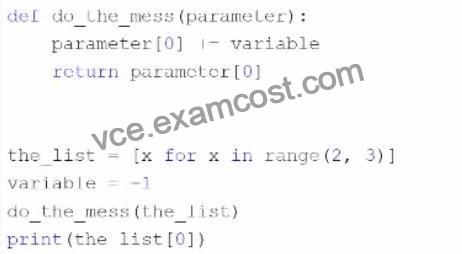
What is the expected result of running the following code?
Explanation
The code snippet that you have sent is trying to use the index method to find the position of a value in a list.
The code is as follows:
the_list = [1, 2, 3, 4, 5] print(the_list.index(6))
The code starts with creating a list called “the_list” that contains the numbers 1, 2, 3, 4, and 5. Then, it tries to print the result of calling the index method on the list with the argument 6. The index method is used to return the first occurrence of a value in a list. For example, the_list.index(1) returns 0, because 1 is the first value in the list.
However, the code has a problem. The problem is that the value 6 is not present in the list, so the index method cannot find it. This will cause a ValueError exception, which is an error that occurs when a function or operation receives an argument that has the right type but an inappropriate value. The code does not handle the exception, and therefore it will terminate with an error message.
The expected result of the code is an unhandled exception, because the code tries to find a value that does not exist in the list. Therefore, the correct answer is C. The code raises an unhandled exception.
QUESTION 15
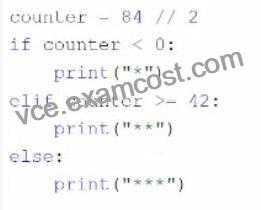
What is the expected output of the following code?
Explanation
The code snippet that you have sent is a conditional statement that checks if a variable “counter” is less than 0, greater than or equal to 42, or neither. The code is as follows:
if counter < 0: print(“”) elif counter >= 42: print(“”) else: print(“”) The code starts with checking if the value of “counter” is less than 0. If yes, it prints a single asterisk () to the screen and exits the statement. If no, it checks if the value of “counter” is greater than or equal to 42. If yes, it prints three asterisks () to the screen and exits the statement. If no, it prints two asterisks () to the screen and exits the statement.
The expected output of the code depends on the value of “counter”. If the value of “counter” is 10, as shown in the image, the code will print two asterisks (**) to the screen, because 10 is neither less than 0 nor greater than or equal to 42. Therefore, the correct answer is C. * *
QUESTION 17
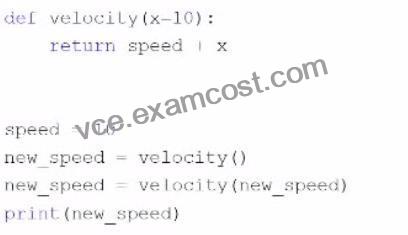
What is the expected result of the following code?
Explanation
The code snippet that you have sent is trying to use the global keyword to access and modify a global variable inside a function. The code is as follows:
speed = 10 def velocity(): global speed speed = speed + 10 return speed print(velocity()) The code starts with creating a global variable called “speed” and assigning it the value 10. A global variable is a variable that is defined outside any function and can be accessed by any part of the code. Then, the code defines a function called “velocity” that takes no parameters and returns the value of “speed” after adding 10 to it. Inside the function, the code uses the global keyword to declare that it wants to use the global variable
“speed”, not a local one. A local variable is a variable that is defined inside a function and can only be accessed by that function. The global keyword allows the function to modify the global variable, not just read it. Then, the code adds 10 to the value of “speed” and returns it. Finally, the code calls the function “velocity” and prints the result.
However, the code has a problem. The problem is that the code uses the global keyword inside the function, but not outside. The global keyword is only needed when you want to modify a global variable inside a function, not when you want to create or access it outside a function. If you use the global keyword outside a function, you will get a SyntaxError exception, which is an error that occurs when the code does not follow the rules of the Python language. The code does not handle the exception, and therefore it will terminate with an error message.
The expected result of the code is an unhandled exception, because the code uses the global keyword incorrectly. Therefore, the correct answer is A. The code is erroneous and cannot be run.
QUESTION 19
What is true about tuples? (Select two answers.)
Explanation
Tuples are one of the built-in data types in Python that are used to store collections of data. Tuples have some characteristics that distinguish them from other data types, such as lists, sets, and dictionaries. Some of these characteristics are:
Tuples are immutable, which means that their contents cannot be changed during their lifetime. Once a tuple is created, it cannot be modified, added, or removed. This makes tuples more stable and reliable than mutable data types. However, this also means that tuples are less flexible and dynamic than mutable data types. For example, if you want to change an element in a tuple, you have to create a new tuple with the modified element and assign it to the same variable12 Tuples are ordered, which means that the items in a tuple have a defined order and can be accessed by using their index. The index of a tuple starts from 0 for the first item and goes up to the length of the tuple minus one for the last item. The index can also be negative, in which case it counts from the end of the tuple. For example, if you have a tuple t = (“a”, “b”, “c”), then t[0] returns “a”, and t[-1] returns “c”12 Tuples can be indexed and sliced like lists, which means that you can get a single item or a sublist of a tuple by using square brackets and specifying the start and end index. For example, if you have a tuple t
= (“a”, “b”, “c”, “d”, “e”), then t[2] returns “c”, and t[1:4] returns (“b”, “c”, “d”). Slicing does not raise any exception, even if the start or end index is out of range. It will just return an empty tuple or the closest possible sublist12 Tuples can contain any data type, such as strings, numbers, booleans, lists, sets, dictionaries, or even other tuples. Tuples can also have duplicate values, which means that the same item can appear more than once in a tuple. For example, you can have a tuple t = (1, 2, 3, 1, 2), which contains two 1s and two
2s12
Tuples are written with round brackets, which means that you have to enclose the items in a tuple with parentheses. For example, you can create a tuple t = (“a”, “b”, “c”) by using round brackets. However, you can also create a tuple without using round brackets, by just separating the items with commas. For example, you can create the same tuple t = “a”, “b”, “c” by using commas. This is called tuple packing, and it allows you to assign multiple values to a single variable12 The len() function can be applied to tuples, which means that you can get the number of items in a tuple by using the len() function. For example, if you have a tuple t = (“a”, “b”, “c”), then len(t) returns 312 An empty tuple is written as (), which means that you have to use an empty pair of parentheses to create a tuple with no items. For example, you can create an empty tuple t = () by using empty parentheses.
However, if you want to create a tuple with only one item, you have to add a comma after the item, otherwise Python will not recognize it as a tuple. For example, you can create a tuple with one item t = (“a”,) by using a comma12 Therefore, the correct answers are A.
Tuples are immutable, which means that their contents cannot be changed during their lifetime. and D. Tuples can be indexed and sliced like lists.
QUESTION 22
What is true about exceptions and debugging? (Select two answers.)
Explanation
Exceptions and debugging are two important concepts in Python programming that are related to handling and preventing errors. Exceptions are errors that occur when the code cannot be executed properly, such as syntax errors, type errors, index errors, etc. Debugging is the process of finding and fixing errors in the code, using various tools and techniques. Some of the facts about exceptions and debugging are:
A tool that allows you to precisely trace program execution is called a debugger. A debugger is a program that can run another program step by step, inspect the values of variables, set breakpoints, evaluate expressions, etc. A debugger can help you find the source and cause of an error, and test possible solutions. Python has a built-in debugger module called pdb, which can be used from the command line or within the code. There are also other third-party debuggers available for Python, such as PyCharm, Visual Studio Code, etc12 If some Python code is executed without errors, this does not prove that there are no errors in it. It only means that the code did not encounter any exceptions that would stop the execution. However, the code may still have logical errors, which are errors that cause the code to produce incorrect or unexpected results. For example, if you write a function that is supposed to calculate the area of a circle, but you use the wrong formula, the code may run without errors, but it will give you the wrong answer. Logical errors are harder to detect and debug than syntax or runtime errors, because they do not generate any error messages. You have to test the code with different inputs and outputs, and compare them with the expected results34 One try-except block may contain more than one except branch. A try-except block is a way of handling exceptions in Python, by using the keywords try and except. The try block contains the code that may raise an exception, and the except block contains the code that will execute if an exception occurs. You can have multiple except blocks for different types of exceptions, or for different actions to take. For example, you can write a try-except block like this:
try: # some code that may raise an exception except ValueError: # handle the ValueError exception except ZeroDivisionError: # handle the ZeroDivisionError exception except: # handle any other exception This way, you can customize the error handling for different situations, and provide more informative messages or alternative solutions5 The default (anonymous) except branch can be the last branch in the try-except block. The default except branch is the one that does not specify any exception type, and it will catch any exception that is not handled by the previous except branches. The default except branch can be the last branch in the try-except block, but it cannot be the first or the only branch. For example, you can write a try-except block like this:
try: # some code that may raise an exception except ValueError: # handle the ValueError exception except: # handle any other exception This is a valid try-except block, and the default except branch will be the last branch. However, you cannot write a try-except block like this:
try: # some code that may raise an exception except: # handle any exception This is an invalid try-except block, because the default except branch is the only branch, and it will catch all exceptions, even those that are not errors, such as KeyboardInterrupt or SystemExit. This is considered a bad practice, because it may hide or ignore important exceptions that should be handled differently or propagated further. Therefore, you should always specify the exception types that you want to handle, and use the default except branch only as a last resort5 Therefore, the correct answers are A. A tool that allows you to precisely trace program execution is called a debugger. and C. One try-except block may contain more than one except branch.
QUESTION 24
Arrange the binary numeric operators in the order which reflects their priorities, where the top-most position has the highest priority and the bottom-most position has the lowest priority.


Explanation
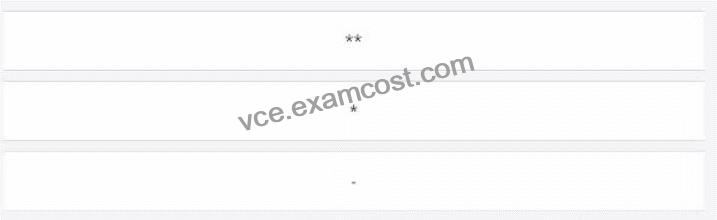
The correct order of the binary numeric operators in Python according to their priorities is:
Exponentiation (**)
Multiplication (*) and Division (
Addition (+) and Subtraction (
This order follows the standard mathematical convention of operator precedence, which can be remembered by the acronym PEMDAS (Parentheses, Exponents, Multiplication/Division, Addition/Subtraction). Operators with higher precedence are evaluated before those with lower precedence, but operators with the same precedence are evaluated from left to right. Parentheses can be used to change the order of evaluation by grouping expressions.
For example, in the expression 2 + 3 * 4 ** 2, the exponentiation operator (**) has the highest priority, so it is evaluated first, resulting in 2 + 3 * 16. Then, the multiplication operator (*) has the next highest priority, so it is evaluated next, resulting in 2 + 48. Finally, the addition operator (+) has the lowest priority, so it is evaluated last, resulting in 50.
You can find more information about the operator precedence in Python in the following references:
6. Expressions – Python 3.11.5 documentation
Precedence and Associativity of Operators in Python – Programiz
Python Operator Priority or Precedence Examples Tutorial


